

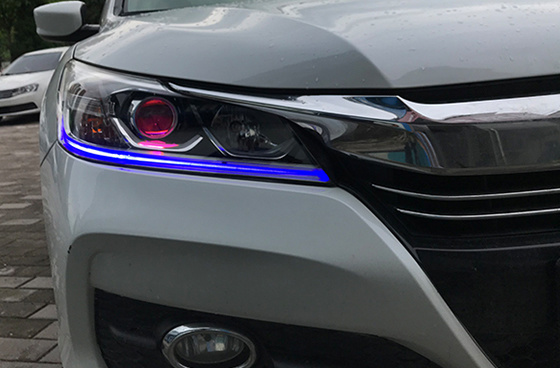
With the segmentation of LED application market growth, more and more experienced experts are realizing that demand from the traditional mobile phone sector will not drive significant growth in the LED industry this year and next. However, due to the optimistic outlook for the emerging automotive lighting LED market, most industry insiders believe that the automotive LED market will become the main growth driver for the LED market in the future.
Domestic spot market data shows that since the second half of last year, the LED market has seen a significant decline in revenue and profits for many LED manufacturers due to weaker-than-expected mobile phone growth. Consequently, industry players are anticipating growth in other LED sectors this year.
Due to the current limited growth potential of the global mobile phone market, industry players have been cautious about the growth momentum of the LED market this year. With the recent emergence of new application markets such as automotive lighting and backlighting, industry players predict that the LED market will leverage automotive applications and maintain its growth trend this year. Although major LED manufacturers are still in the development and certification stages in the three major application markets of automotive lighting, backlighting, and lighting, and the lack of demand has resulted in a small contribution to industry growth this year, with the acceleration of industrialization, industry players believe that major LED manufacturers will have a large number of applications in these three areas next year. Regarding the market development of LED automotive lighting, industry experts believe that some high-end cars in the United States, Japan, and Europe have already begun to partially utilize LED lighting. With the rapid development of China’s economy, the automobile and motorcycle industries have experienced rapid growth in recent years, and the demand for supporting products such as automotive and motorcycle lights is expected to rise in tandem.
Although the LED automotive lighting market expanded slowly in the past few years, it has accelerated since 2002. Rapid growth is expected within the next two years, with the possibility that one or two lights (such as rear brake lights and turn signals) in every car’s front and rear combination lights will use LED light sources.
LEDs are known as the fourth generation of automotive lighting. Experienced experts believe that, despite their higher initial investment, LED headlights offer advantages over incandescent lamps, such as high quality and premium design.
Reportedly, in recent years, renowned car brands such as BMW, Ford, Honda, Toyota, Mercedes-Benz, Audi, and Lexus have spared no effort in exploring new selling points and launching a variety of new models to attract customers, resulting in the development of attractive and colorful headlight designs. LED lamps, the fourth-generation automotive light source, have been effectively utilized by numerous automakers to create stunning headlight designs. LED headlights offer numerous advantages, including zero lag, energy efficiency, long life, low heat generation, shock resistance, and high color purity, making them the inevitable replacement for tungsten and halogen lamps.
In the next five years, LED headlights in my country will experience large-scale development, with annual output value projected to reach 1 billion yuan in the next few years and 3 billion yuan five years from now.
Automotive LED lights are classified into two categories: decorative and functional. Decorative lights are primarily used for interior and exterior beautification and display functions, and currently often utilize control circuits to achieve a variety of color changes. Functional LED lights are best suited for indicator backlighting in digital instrument clusters, front and rear turn signals, brake indicators, position markers, reverse lights, fog lights, and reading lights. The operating requirements for LEDs are generally similar to those for general-purpose LEDs, but with higher requirements for angle control, color gamut, brightness, voltage dispersion, light decay, heat dissipation, UV protection, and reliability. Only by achieving these functional improvements can automotive LEDs achieve true industrialization.